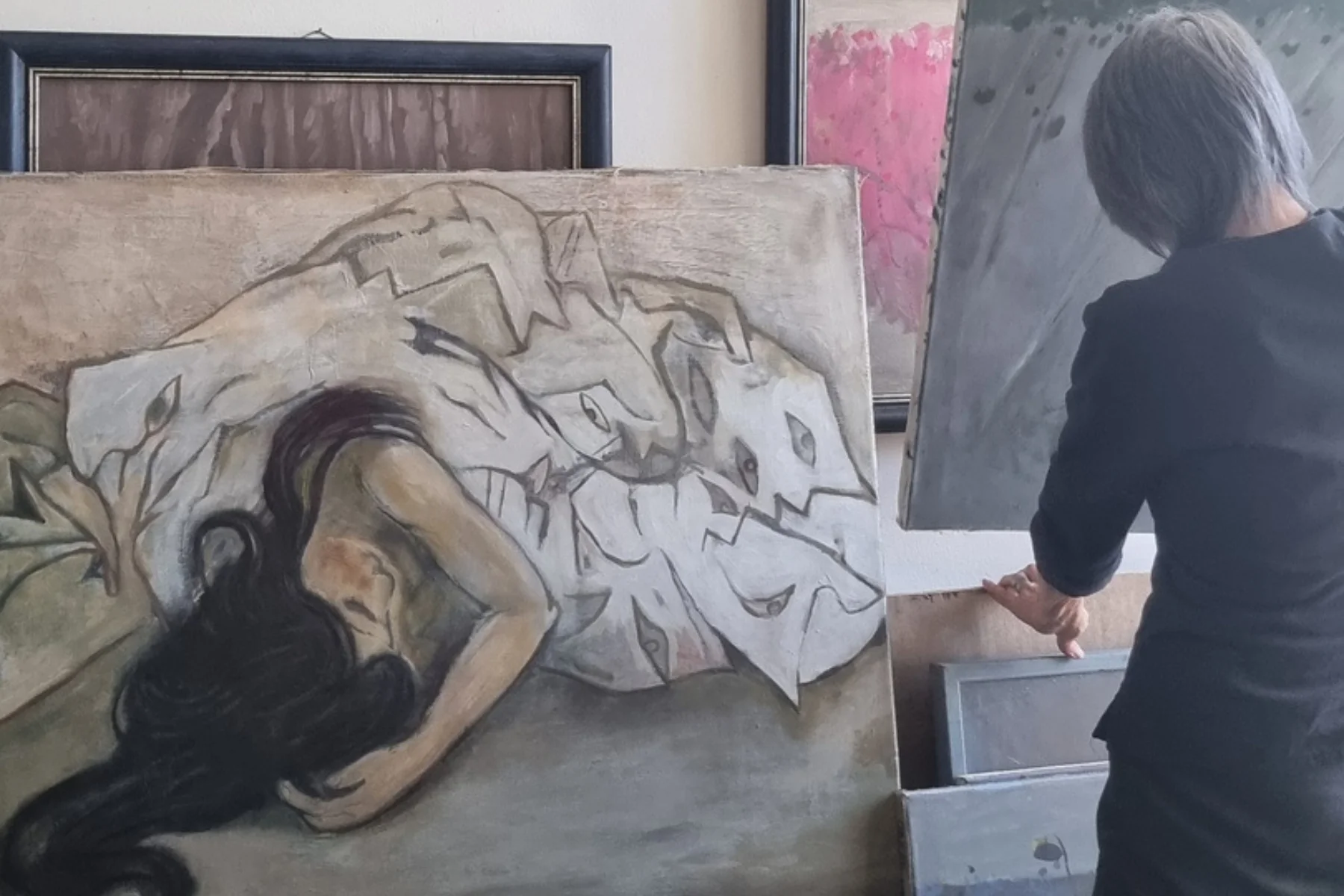
The artist Claudia Borchers was born Mai, in the Việt Bắc jungle in 1950, daughter of a German Foreign Legion deserter turned Việt Minh propagandist and a Vietnamese seamstress. Renamed Việt-Đức on the eve of Điện Biên Phủ, she grew up in Hanoi, emigrated to the GDR as a teenager not speaking German, and became a painter within East Germany’s state art system – training in oil painting and printmaking at the Dresden Academy, teaching factory workers in Premnitz, working through reunification’s collapse as an interpreter for Vietnamese contract workers whose legal status had dissolved overnight.
I met Claudia nearly thirty years ago, when I was in my mid-twenties looking for other half-Vietnamese faces in a Berlin that had very few at the time. This piece, intended as the first in a series of portraits of Việt Kiều in Berlin, returns to her studio in Weissensee to speak about border-crossing, caregiving, painting, and what she calls the practice of belonging.
The back building on Bizetstrasse in Weissensee, Berlin, still bears the imprint of the Berlin I have known for three decades – improvised, subsidized, and now slowly disappearing. Built around the turn of the last century, the long red-brick factory later housed an East German lightbulb plant, and, after the Wall fell, was purchased and converted with state support into affordable live-work spaces for artists. When I first visited Claudia Borchers nearly thirty years ago, Weissensee still felt peripheral; a non-German face could draw open curiosity or a hostile stare, depending on the block. Today, the district is as international as the rest of the capital. And like much of Berlin, the collective around Claudia – many of them still working well past retirement age – now faces rising rents and uncertain futures, as the subsidy that sustained them expires.